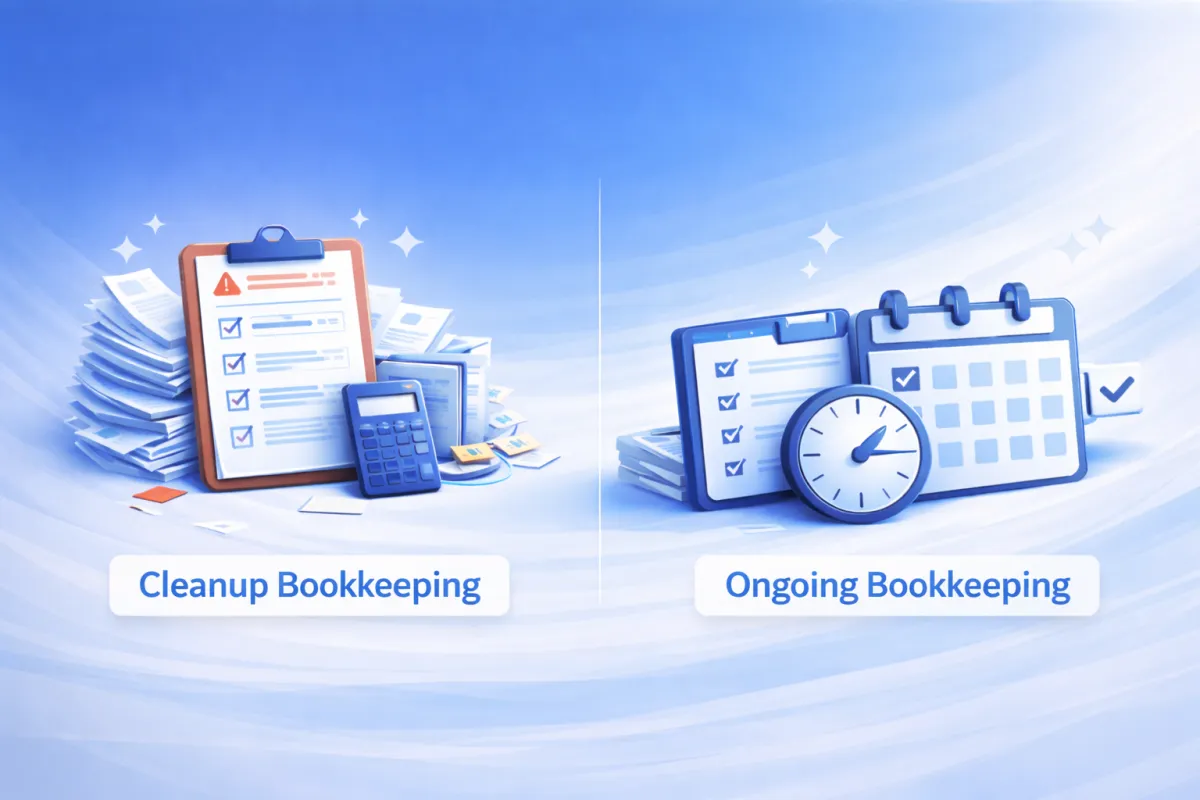
Cleanup vs Ongoing Bookkeeping
Cleanup vs Ongoing Bookkeeping: How to Know What You Need and What It Takes to Catch Up
If your books are behind or unreliable, there are usually two paths:
Cleanup or catch-up to repair past months
Ongoing bookkeeping to keep everything current on a monthly cadence
Most teams wait too long because they are not sure which one they need, or they assume “we’ll just start doing it monthly again” and the past will sort itself out. It rarely does.
This guide helps you diagnose what you actually need, what it takes to catch up, and how to avoid slipping behind again.
First, quick definitions in plain language
What catch-up bookkeeping means
Catch-up bookkeeping is getting transactions entered for months that were never completed. It is focused on filling in missing months so the books are current.
What bookkeeping cleanup means
Cleanup is correcting and reconciling what is already in the system so balances match reality and are supported by statements and schedules. It focuses on fixing miscategorization, duplicates, messy reconciliations, and broken flows.
What ongoing bookkeeping means
Ongoing bookkeeping is the monthly rhythm that keeps you current: collecting documents, reconciling accounts, posting accruals, and producing usable reports. Month-end close is the foundation for reliable reporting and better decisions.
How to know what you need: a simple decision tree
You likely need ongoing bookkeeping only if all of this is true:
You are at most one month behind
Bank and credit cards reconcile cleanly
You trust your balance sheet
Your income statement looks plausible month to month
If that describes you, the best move is to set a close cadence and keep it consistent.
You likely need catch-up or cleanup first if any of these are true:
You are 2+ months behind
Reconciliations have not been done in a while
Stripe or processor payouts do not tie out
Payroll entries are missing or inconsistent
Reports feel wrong, jumpy, or hard to explain
Your accountant asks for documents you cannot find quickly
When reconciliations are broken, starting fresh this month does not fix the underlying gap. Reconciliation is the backbone of accurate month-end reporting.
Common symptoms and what they usually mean
Symptom: “We have transactions in the system, but numbers feel off”
Most likely: cleanup
You probably have duplicate feeds, miscategorized items, incorrect opening balances, or reconciliations that were forced.
Cleanup is about making the books defensible with supporting evidence.
Symptom: “We just never finished the last few months”
Most likely: catch-up
You need to enter missing data, reconcile monthly, and get current.
Symptom: “We are behind and also not sure we trust what is there”
Most likely: both catch-up and cleanup
This is common. You fill gaps and correct errors at the same time.
What it takes to catch up cleanly
Think of catch-up as a short project with three ingredients:
Complete inputs
A fixed order of operations
A clear definition of done
The minimum inputs you need
To rebuild accurate books, you typically need:
Bank statements and credit card statements
Processor statements or payout reports
Payroll reports and filings, if applicable
Loan statements
Invoices, bills, and receipts access
Access to the accounting file and connected tools
Supporting documents matter because tax and compliance rules rely on substantiation. Both the CRA and the IRS expect businesses to keep records long enough to support income, deductions, payroll, and tax filings, and transactions should be supported by records such as purchases, sales, payroll, and other business documents.
The order of operations that prevents rework
A reliable catch-up sequence usually looks like this:
Lock the period and define cutoffs
Fix bank feeds and connections
Reconcile bank and credit cards month by month
Reconcile payment processors and clearing accounts
Confirm payroll entries and liabilities
Review AR and AP, if relevant
Clean up chart of accounts and rules
Run a reasonableness review and variance check
Package support and notes so it is explainable
Reconciliation first is key because it anchors everything else.
How long does catch-up usually take?
The honest answer is: it depends on how many months, how messy the file is, and how quickly you can provide statements and access.
As a general reference, some bookkeeping providers estimate that 2 to 6 months of catch-up can often be completed in about 30 days when statements and basic documents are available. Treat this as a directional benchmark, not a guarantee.
What drives timeline most:
Missing statements or incomplete access
Payroll complexity and mispostings
Processor reconciliation complexity
Multi-currency or multi-entity setups
Volume of transactions
What ongoing bookkeeping should include after you catch up
Catching up is not the finish line. You want a system that stays stable.
A solid ongoing monthly package typically includes:
Document capture and approvals workflow
Monthly reconciliations for bank, cards, and key balance sheet accounts
Review of recurring categories and rules
Accruals and deferrals as needed
A simple close checklist with owners and dates
Reporting with short variance notes so leaders can act
Month-end close best practices consistently point to standardizing procedures, using checklists, and using technology to reduce manual effort and improve timeliness.
Mistakes that make catch-up harder than it needs to be
Mixing months together
Trying to just reconcile everything at once creates confusion. Close month by month.
Starting with categorization instead of reconciliation
Categories will change as you discover what is missing. Anchor cash and clearing first.
Skipping documentation
If you cannot prove what happened, you cannot stand behind the numbers. Both the CRA and the IRS can require businesses to substantiate deductions, expenses, and entries with proper records.
Quick FAQ
Is cleanup the same as catch-up?
Not exactly. Catch-up fills missing months. Cleanup corrects and reconciles errors in existing records. Many companies need a mix of both.
If we are behind, can we just start fresh this month?
You can, but the old problems usually show up later in taxes, investor questions, or cash flow surprises. Reconciliations and support are what make reports reliable.
What is the first thing we should do?
Collect statements and access, then reconcile bank and credit cards month by month. That creates a reliable foundation.
