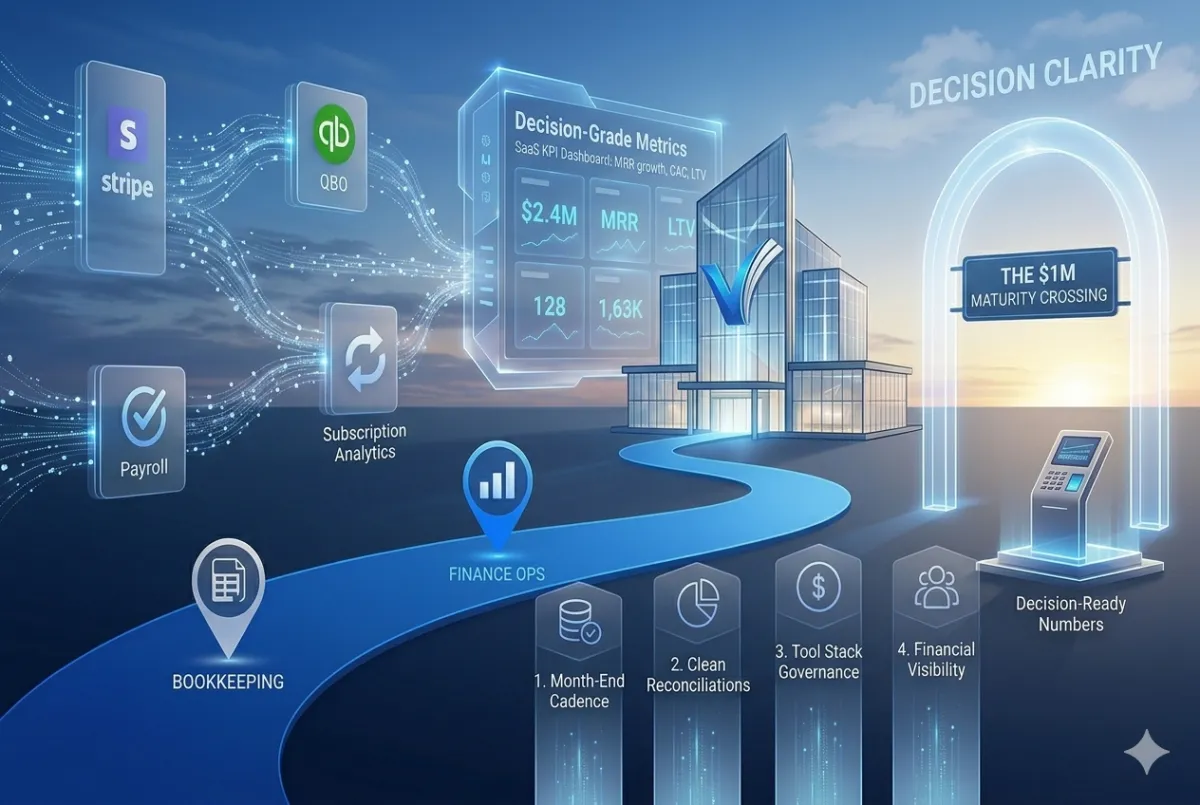
Finance Ops for SaaS: What Changes After $1M in Revenue or Spend
Finance Ops for SaaS: What Changes After $1M in Revenue or Spend
After a SaaS company crosses roughly $1M in revenue or annual spend, finance usually stops being simple bookkeeping.
At this stage, the business needs more than categorized transactions and monthly reports. It needs a finance operating rhythm: a predictable month-end close, reconciled books, clean reporting, cash visibility, payroll and sales tax discipline, tool-stack hygiene, and answers founders can trust while decisions are still timely.
The Real Shift: Before $1M, bookkeeping helps keep the company compliant. After $1M, finance ops helps the company make better decisions.
At Vizhen Books, we call this the move from recordkeeping to decision clarity. Clean books are the foundation. Clear decisions are the outcome.
Why This Matters for SaaS Founders
In the early days, finance can feel manageable:
Revenue comes through Stripe.
Payroll runs.
Expenses get categorized.
Someone reconciles the bank accounts.
At month-end, the founder gets a P&L and maybe a balance sheet.
That may be enough for a while. But once a SaaS company starts approaching $1M–$10M in revenue or annual spend, finance becomes more connected to operating decisions.
Founders and operators start asking:
Can we afford the next hire?
Why did cash drop even though revenue grew?
Are we recognizing revenue correctly?
Are Stripe payouts, refunds, fees, and taxes reconciled?
Is payroll mapped clearly enough to understand margins?
Do we know our runway?
Can we answer investor or board questions with confidence?
Are our tools helping finance move faster, or creating more cleanup?
This is where basic bookkeeping starts to feel too reactive. The numbers may exist, but they are not always fast enough, clear enough, or reliable enough to support decisions. That is where finance ops becomes critical.
Bookkeeping vs. Finance Ops: What Actually Changes?
Basic bookkeeping answers: What happened?
Finance ops answers: What happened, why did it happen, can we trust it, and what should we do next?
That difference matters because SaaS companies scale through complexity. More customers, more payment activity, more employees, more tools, more reporting expectations, and more compliance obligations all create more places for the numbers to break.
A strong SaaS finance ops function usually includes:
Month-end close cadence
Bank, credit card, Stripe, payroll, and clearing account reconciliations
Revenue and deferred revenue review
Payroll and contractor payment coordination
GST/HST and sales tax cadence
AP/AR workflows
Cash flow and runway visibility
Budget vs. actual review
SaaS KPI reporting
Tool integrations and automation
Clear ownership, response times, and escalation paths
In other words, the company no longer needs “someone to do the books.” It needs a finance system that keeps pace with growth.
Why $1M is a Finance Maturity Trigger
The $1M mark is not magic. Some SaaS companies need stronger finance ops earlier, especially if they are funded, hiring quickly, selling across borders, or running a complex tool stack. Others may not feel the pressure until later.
But $1M in revenue or annual spend is often where the cracks become visible. You may notice:
Month-end reports arrive too late to use.
The P&L changes after leadership already reviewed it.
Stripe payouts do not match revenue.
Payroll and contractor costs are hard to analyze.
Tools are connected, but not controlled.
Cash feels tight even when sales look strong.
Sales tax settings and filings feel unclear.
Investors or advisors ask for numbers you cannot produce quickly.
The founder is still translating financial reports manually.
At this stage, finance is not just an admin function. It becomes part of how the business manages growth, risk, hiring, cash, pricing, and investor confidence.
The Biggest Shift: Cash, Revenue, and Performance are Not the Same Thing
This is one of the most important finance lessons for SaaS founders.
A customer may pay upfront for an annual subscription. Cash goes up today. But depending on the contract and accounting treatment, that revenue may need to be recognized over the service period. That means the cash balance, revenue line, and deferred revenue balance can all tell different parts of the story.
For a founder, the practical question is simple: Are we looking at cash collected, revenue earned, or revenue we still need to deliver?
If that question is not clear, decision-making gets risky. You may think the company is healthier than it is, or you may underinvest because the P&L and cash picture are not telling the same story.
A stronger finance ops process helps separate:
Cash collected
Revenue recognized
Deferred revenue
Refunds and credits
Payment processor fees
Sales tax collected
Failed payments and collections risk
Churn, upgrades, and downgrades
That is why SaaS finance cannot stop at bank reconciliation. The business needs reporting that explains what the numbers mean.
Month-End Close Needs Structure, Not Heroics
For a growing SaaS company, month-end close should not depend on last-minute chasing, inbox searches, or one person remembering every exception. It needs a cadence.
A good close cadence answers:
What gets reviewed?
Who owns each input?
When are cutoffs?
When are the books locked?
When does reporting land?
What happens if something is missing?
What requires commentary?
A practical SaaS close rhythm may look like this:
Days 1–3: Collect missing documents, review open items, lock prior-month activity.
Days 4–6: Reconcile bank, credit cards, Stripe, payroll, AP/AR, and clearing accounts.
Days 7–9: Review revenue, deferred revenue, accruals, sales tax, unusual expenses, and variances.
Day 10: Deliver the reporting package with clear notes and action items.
The goal is not speed for the sake of speed. The goal is useful speed.
Reports that arrive three or four weeks later may still be accurate, but they are often too late to guide hiring, spending, collections, pricing, or cash decisions. A consistent month-end close helps founders avoid making decisions on stale or incomplete information.
Tool Complexity Becomes a Finance Risk
Most SaaS companies do not wake up one day and decide to build a messy finance stack. It happens gradually.
A tool is added for payments. Another for payroll. Another for expenses. Another for AP. Another for subscription metrics. Another for forecasting. Another spreadsheet appears because the reports are not quite right. Before long, the team has tools everywhere—but no clear source of truth.
A typical SaaS finance stack may include:
Stripe or another payment processor
QuickBooks Online or Xero
Payroll software
Expense management
Bill pay or AP approvals
CRM
Subscription analytics
Corporate cards
Forecasting spreadsheets or dashboards
Each tool can be useful. The problem is the handoff between tools. When no one owns how data flows, the finance team ends up with:
Broken bank feeds
Duplicate transactions
Unreconciled clearing accounts
Manual journal entries
Inconsistent coding
Spreadsheet workarounds
Delayed reporting
Low trust in the numbers
This is why “modern finance ops” is not just about having modern tools. It is about having tools, rules, reviews, and ownership. More tools do not automatically create better finance ops. Better finance ops comes from a system that makes the tools work together.
Sales Tax and Compliance Get Harder to Ignore
For Canadian SaaS and digital businesses, GST/HST and cross-border digital economy rules can become more important as the company grows. For SaaS founders, this is not just a tax issue. It is a finance ops issue.
Sales tax touches:
Customer location data
Billing setup
Stripe or invoicing configuration
Accounting records
Tax liability accounts
Filing cadence
Documentation
Cash planning
Common issues include:
Tax settings are configured inconsistently
Customer location data is incomplete
Sales tax collected does not match accounting records
Remittance deadlines are handled reactively
Liabilities are not reviewed monthly
Documentation is scattered across systems
At small scale, this may feel manageable. At $1M+ revenue or spend, it becomes operational risk. A stronger finance cadence keeps compliance from becoming a year-end scramble.
Founders Need Visibility, Not Just Reports
Most founders do not want more reports. They want better answers. They want to know:
How much runway do we have?
Can we afford the next hire?
Which costs are growing too quickly?
Why did margins change?
Are collections slowing down?
Are we ready for investor questions?
Is our finance stack helping or slowing us down?
What should we fix first?
A financial report without explanation creates more work for the founder.
The Decision-Ready Difference:
A standard financial report says: "Here are the numbers."
A decision-ready report explains: What changed, why it changed, what matters, what needs action, and what to watch next month.
That is the difference between finance as a reporting obligation and finance as a management system. Clean books matter. But clean books are not the goal. They are the prerequisite for confident decisions about hiring, spending, growth, and risk.
Signs Your SaaS Company Has Outgrown Basic Bookkeeping
You may have outgrown basic bookkeeping if these problems keep repeating:
You get reports too late to use
If reporting lands halfway through the next month or later, you are making decisions with stale information.
Your P&L keeps changing
If numbers shift after leadership reviews them, the close process likely needs stronger cutoffs, reconciliations, and ownership.
Stripe does not reconcile cleanly
Payment processor activity needs a repeatable process for fees, refunds, disputes, taxes, timing differences, and payouts.
You cannot answer runway questions quickly
If every runway conversation requires rebuilding a spreadsheet, the finance system is too manual.
Payroll and expenses are hard to analyze
Once headcount grows, payroll, benefits, contractors, software, and departments need consistent coding.
You are adding tools but not reducing admin
If every new tool creates more exports, exceptions, and manual review, the stack needs governance.
Investors or advisors ask for numbers you cannot produce confidently
This is often the moment founders realize they do not just need bookkeeping. They need reporting discipline.
The founder is still the finance translator
If the founder has to explain the reports, chase the answers, or reconcile the story manually, finance is not yet operating as a system.
What a Modern SaaS Finance Cadence Looks Like
A strong SaaS finance cadence does not need to be overbuilt. It needs to be consistent.
Weekly Rhythm
Review: Cash balance, upcoming payroll, major vendor payments, failed payments and collections, urgent AP/AR issues, bank feed or tool sync problems.
Weekly question: Is anything happening that could affect cash, payroll, customers, or decision-making this month?
Monthly Rhythm
Review: Closed books, P&L, balance sheet, cash summary, Stripe/payment reconciliation, payroll reconciliation, sales tax liability, revenue and deferred revenue, budget vs. actual, burn and runway, variance notes, action items.
Monthly question: What changed, why did it change, and what should we do next?
Quarterly Rhythm
Review: Forecast assumptions, hiring plan, sales and retention assumptions, margin trends, tool stack gaps, compliance and documentation health, board or investor reporting needs.
Quarterly question: Is our finance system keeping up with the business we are becoming?
That is modern finance ops: a reliable operating rhythm that helps the company move faster with less second-guessing.
What Should Be in a SaaS Finance Reporting Package?
A useful SaaS finance package should be simple enough for founders to use and structured enough for leadership, investors, lenders, or advisors to trust.
A strong monthly package may include:
Profit and loss statement
Balance sheet
Cash summary
AR/AP summary
Stripe/payment processor reconciliation notes
Revenue and deferred revenue notes
Payroll and headcount cost summary
Sales tax liability review
Budget vs. actual
Burn and runway view
Key SaaS metrics, if applicable
Variance commentary
Action items for the next month
The commentary matters. A report without commentary says, “Here are the numbers.” A better report says, “Here is what changed, here is why it changed, and here is what needs attention.” That is what makes the numbers decision-grade.
What to Fix First After $1M
If your SaaS finance process feels reactive, do not try to fix everything at once. Start here:
Stabilize the close: Define what gets closed, when it gets closed, and who owns each input.
Clean up reconciliations: Review bank, credit card, Stripe, payroll, AP/AR, sales tax, and clearing accounts consistently.
Standardize the reporting package: Create one monthly package that leadership can understand and compare over time.
Review tool flows: Identify where data breaks, duplicates, or creates manual cleanup.
Build a runway view: Once the books are reliable, connect reporting to cash planning and hiring decisions.
Create an escalation path: When something is missing, unclear, or urgent, everyone should know who owns the answer.
This does not require a huge internal finance team. It requires a clear finance operating system.
Where Vizhen Books Fits
Vizhen Books helps growing SaaS and tool-heavy businesses move from reactive bookkeeping to decision-grade finance operations.
That means:
A predictable month-end close
Reconciled books founders can trust
Clear explanations of what changed
Cash and runway visibility
Tool and workflow cleanup
Payroll, sales tax, AP, and AR discipline
Practical problem-solving across systems
Fast answers and real ownership
The goal is not to add complexity. The goal is to make finance calmer, cleaner, and more useful.
Clean books are the foundation.
Clear decisions are the outcome.
The Real Milestone: Decision-Ready Numbers
Crossing $1M in revenue or annual spend is not just a growth milestone. It is a finance maturity milestone.
You may not need a full-time CFO yet. You may not need a large internal finance team. But you probably need more than basic bookkeeping. You need a finance rhythm that keeps up with the business:
Close faster
Trust the numbers
Know your runway
Reduce tool chaos
Catch issues before they become problems
Make decisions with confidence
That is the shift from bookkeeping to finance ops. Bookkeeping keeps records clean. Finance ops helps the business move with clarity.
Clean books. Clear decisions.
Ready to see what your finance function needs next?
If your SaaS company is crossing $1M in revenue or annual spend, or your finance process is starting to feel too reactive, start with a quick fit check.
