Delivery Team Structure- July 2026
How Vizhen Structures Its Delivery Team for a Faster, Reliable Close
Most founders ask the same first question when they start shopping for an accounting partner: which software do you use? It feels like the decision that matters. It is not. The platform, the bank feeds, and the integrations all matter, but none of them is what decides whether your books close on the fifth of the month or the fifteenth.
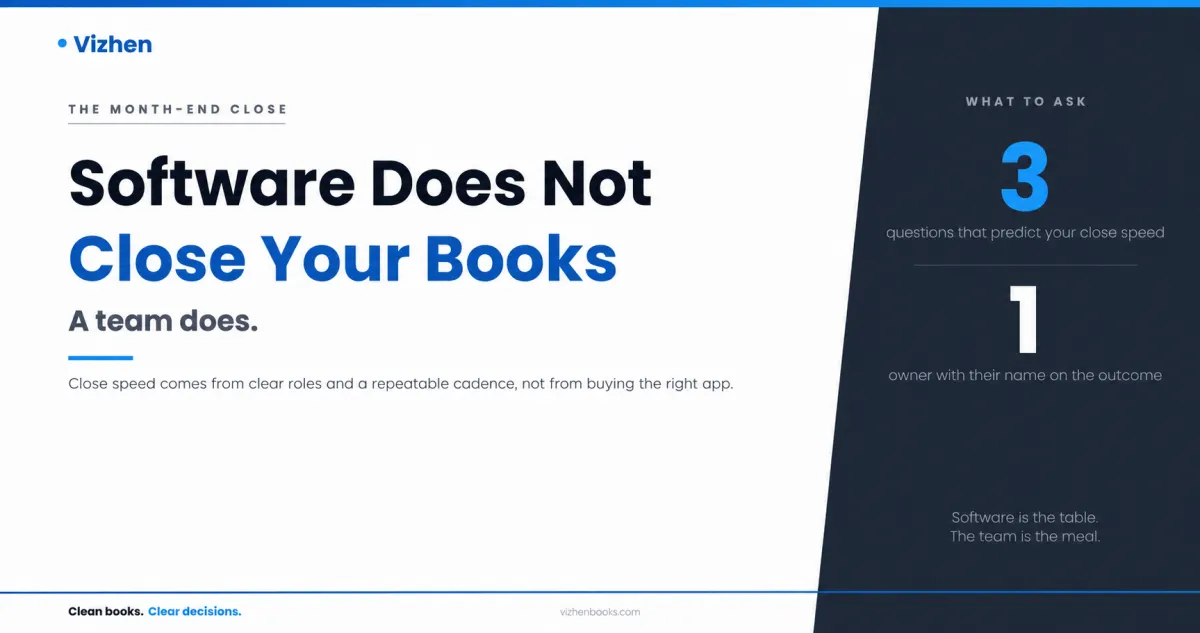
What decides close speed is the shape of the team behind the books. Who owns the file, who reviews the work before it reaches you, and whether any of that depends on one specific person being available that week. A fast, reliable close is the output of clear roles and a repeatable cadence, not the output of buying the right app.
This is how Vizhen, a Canadian accounting and finance operations firm and the winner of Advisory Innovator of the Year, structures its delivery team to produce a close you can trust, and why that structure is the thing to evaluate when you compare accounting companies in Canada.
Why most closes are slow, and what it actually costs
Growing businesses do not struggle because they lack reports. They struggle for four reasons we see again and again: financials arrive too late to be useful, the numbers do not feel fully trustworthy, no one clearly owns the outcome, and systems break as complexity increases.
When that happens, finance stops being supportive and becomes stressful. Founders start making decisions on instinct because the numbers are not ready when the decision is. A hire, a price change, a spend cut that cannot wait. The cost of a slow close is not the extra days of bookkeeping. It is every decision made without reliable numbers in front of you.
Most firms optimize for compliance. Vizhen optimizes for clarity, so you can make confident calls on hiring, spending, growth, and risk.
The Vizhen delivery model: an accounting department, not a vendor
Vizhen does not run as a vendor that hands you a deliverable each month. It runs like your internal accounting department, with the structure an internal department would have: a clear owner, a predictable close cadence, and a team that takes responsibility for outcomes, not just tasks.
At the core is a controller-owned month-end close. Bank rules and automated categorization are configured for each client at onboarding, which keeps data clean at the point of entry rather than requiring correction at close. That single discipline accounts for more cumulative time saved across the portfolio than almost any other practice.
Throughout the engagement, five things stay constant:
A clear owner. One accountable person on your file, not a rotating pool.
A defined calendar. You know when your books close and when your numbers arrive.
Proactive communication. Issues are surfaced before you have to ask.
Modern systems. Cloud-based accounting and automation applied where they add value.
Continuous improvement. The process gets sharper every month, not just maintained.
Why the single owner matters more than anything
The detail founders overlook is ownership. When a company loses its CFO without warning, payroll still runs, month-end still comes, and investors still expect reporting. One Vizhen client faced exactly that situation, and within a year their CEO described the team as an integral part of their own.
That outcome is not luck. It is what happens when there is always someone whose name is on the outcome, not just the task. Being passed between team members during a critical month is not a service experience. It is a warning sign.
The structure scales with you, it does not get swapped out
A common failure mode in accounting services is that the moment your business gets more complex, the team that served you well gets replaced by a different, more junior one. Vizhen layers roles instead of replacing them.
Core gives you a day-to-day accounting function with controller-level oversight. Growth adds controller-owned close discipline, controls, and system hygiene so the numbers are decision-grade. Strategic Partner adds runway, forecasting, and board-ready reporting on top of that clean base.
The base never disappears as you grow. It deepens. That is the difference between a finance function that holds up under board scrutiny and one that quietly falls behind as the business gets more complex.
A worked example: reconciling your payment processor
To see why team structure beats tooling, look at the reconciliation task that breaks more closes than any other for businesses taking online payments: reconciling a payment processor like Stripe.
The processor collects the full amount a customer pays, deducts its fees, and deposits only the net amount, often bundling several days of charges, refunds, and fees into a single payout. So the deposit that lands in your bank rarely matches any single invoice. Record that net deposit as revenue and your income is understated while your processing fees disappear from the books.
The fix is not a clever app. It is a defined process: record sales at gross, post fees and refunds to their own accounts, and route everything through a dedicated clearing account. The bank payout is then matched against that clearing account rather than against individual sales, so it returns to a clean balance every payout cycle. Vizhen codifies rules like this for each client and reviews the exceptions before anything touches the books.
Automation handles the routine, high-confidence matches. It does not handle the edge cases, and a payment processor produces them constantly: a refund that settles in the next month, a chargeback with its own fee, a multi-currency charge that converts at a different rate than it was invoiced. Those still need a person to review them, which is exactly why the team, not the tool, is what keeps the books reconciled.
How to evaluate an accounting partner
If close speed comes from team structure rather than tooling, then comparing top-rated accounting firms in Canada means asking structural questions, not feature questions. Three are worth more than the rest.
Who owns my file, by name? If the answer is a pool, a queue, or a rotating roster, expect the close to move at the speed of whoever happens to be free. If the answer is a specific person with a specific reviewer above them, you have found a team built for reliability.
When do I get my numbers, and who reviews them first? A defined close calendar signals that the team treats the close as a repeatable process with owners and deadlines. A partner who cannot tell you when your books will close is describing a process that will drift.
What happens when someone is out? This is the question most founders forget to ask, and it exposes the difference between a team and an individual. A team built on documented process absorbs an absence without missing a close. A team built on one heroic person does not.
Those three answers will tell you more about your future close speed than any feature list.
The bottom line
A fast, reliable close is produced by a team that is structured for it: clear ownership, a controller layer that reviews the work, a repeatable cadence, and processes like clearing-account reconciliation that are owned rather than left to chance. The software is real and it matters, but it is the table, not the meal.
What you are actually choosing when you choose an accounting partner is the shape of the team behind your books, because that shape decides whether you can trust your numbers when a decision will not wait.
Clean books. Clear decisions.
Vizhen is a bookkeeping and finance operations firm for growing Canadian and American businesses. We help founders get clean books, fast answers, and the clarity to make better decisions. Book a 15-minute Fit Check atvizhenbooks.com
